


Divorce is complicated enough when all of your finances are in one place. When accounts, real estate, or business interests sit in another country, the process becomes far more difficult.
That is true whether you are the spouse who just learned your partner has been holding assets overseas, or the spouse who has always managed the international side of your household finances and is now trying to understand what Illinois law requires of you.
What many people do not realize is that Illinois divorce law does not stop at the border. Assets built during a marriage belong to the marriage, regardless of which country they are held in.
Foreign accounts, overseas property, and international investments are all part of the marital estate. Both spouses have legal obligations to disclose them.
These cases take more time, more resources, and more expertise than a standard Illinois divorce. The attorney you work with, and the team they build around your case, makes a real difference in the outcome.
Key Takeaways
- Illinois law treats foreign accounts and property the same as domestic assets. If acquired during the marriage, it is part of the marital estate regardless of where it is held.
- Both spouses are required to disclose all financial accounts and assets, including those held in other countries, as part of the Illinois divorce process.
- Federal reporting forms your spouse filed on foreign accounts can be obtained through standard discovery and can reveal accounts you never knew existed.
- An Illinois court cannot force a foreign bank to act, but it can compel your spouse. Refusing a court order carries serious legal consequences.
- Cases involving foreign assets typically require a team: your divorce attorney, a forensic accountant, and in some situations, legal help in the foreign country as well.
What Counts as an International Asset in an Illinois Divorce
International assets come in many forms. In Chicago, where global business is part of daily life, it is common for a high-net-worth divorce to involve some combination of the following:
- Bank or investment accounts held in a foreign country
- Real estate located outside the United States
- Ownership stakes in a foreign business or company
- Foreign retirement or pension accounts
- Accounts held in another person’s name overseas on behalf of a spouse
- Cryptocurrency held on a foreign exchange
If any of these apply to your situation, your divorce involves international assets. The legal strategy needs to reflect that from the start.
Illinois Law Applies to Foreign Assets the Same as Domestic Ones
The most important thing to understand is this: where an asset is held does not determine whether it is subject to division in your Illinois divorce.
Illinois law defines marital property broadly. Assets acquired during the marriage belong to the marriage. A bank account in Switzerland funded with marital money follows the same rules as a checking account in Naperville.
A vacation home purchased during the marriage is marital property whether it sits in the suburbs or in another country.
There are exceptions. Property owned before the marriage, received as a gift, or inherited may be classified as non-marital. But if marital money was ever deposited into that account or used to improve that property, the picture changes quickly. That issue of commingling assets in an Illinois divorce comes up often in cases involving foreign holdings.
Both spouses are required to disclose everything on a sworn financial statement filed at the start of the divorce process. That obligation covers accounts and property held overseas. Leaving assets off that statement is not a minor oversight. It has real legal consequences.
What Happens When a Spouse Does Not Disclose Foreign Assets
Not every spouse with overseas accounts is hiding them on purpose. But deliberate concealment does happen, and Illinois courts are equipped to address it.
When one spouse omits foreign assets from their sworn financial disclosure, the court has meaningful options. A judge can adjust the property division in the other spouse’s favor, order the concealing spouse to pay attorney fees, or hold that spouse in contempt.
Tax returns are routinely obtained through discovery in Illinois divorces. Those returns can include federal reporting forms listing foreign accounts your spouse was legally required to report to the government each year.
This is often how offshore accounts that were never mentioned come to light. Forensic accountants play a central role in these cases. They trace wire transfers, follow money through layered company structures, and identify accounts a spouse controls without being named on them.
How Your Attorney Investigates Accounts You Did Not Know Existed
Discovery in a divorce case involving international assets looks different from that in a standard case. Your attorney has several formal tools available, and the strategy depends on what is already known and what needs to be uncovered.
Written questions sent to the other spouse, answered under oath, can ask directly about foreign accounts and property. Document requests pull in tax returns, bank statements, wire transfer records, and business filings.
Your attorney can subpoena your spouse’s domestic bank directly to find transfers made to foreign institutions. Depositions allow your attorney to question your spouse in person, under oath, about overseas holdings.
Federal law requires U.S. residents to report foreign bank accounts above a certain value each year. Those reports are part of your spouse’s tax return. When your attorney subpoenas those records, the foreign account disclosures come with them.
That paper trail has revealed accounts in cases where one spouse had no idea the accounts existed.
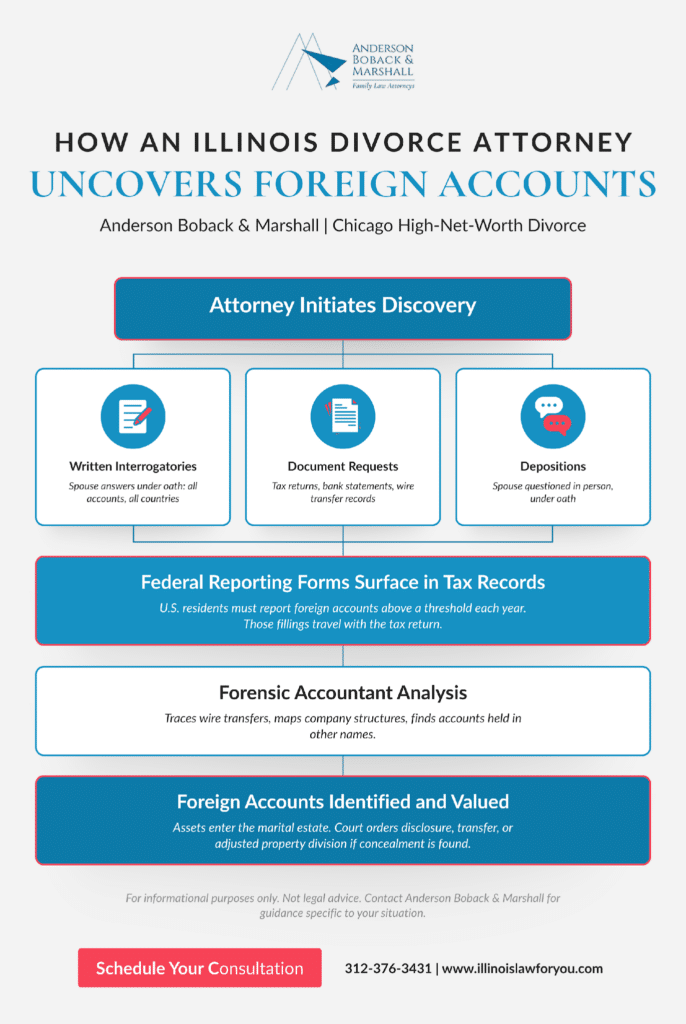
If you suspect assets are being moved or concealed, our overview of finding hidden assets in an Illinois divorce explains what the investigation process looks like and what you can do to protect yourself.
Talk to a Chicago High-Net-Worth Divorce Attorney
Why Valuing Foreign Property Is More Complicated Than It Looks
Identifying a foreign asset is only part of the work. Valuing it accurately is where things become genuinely difficult, and where the wrong approach can affect your settlement in ways that are hard to reverse.
Foreign real estate is not valued the same way as a Chicago home. Appraisers need to understand the local market, local ownership laws, and what the property can realistically sell for in that country.
Currency exchange adds another layer. The value of a foreign account shifts depending on when and how it is converted to U.S. dollars, and timing that conversion is part of the strategy.
Ownership in a foreign business brings its own complications. A stake may come with restrictions on transfer or sale under the laws of that country. What something is worth on paper is not always what it is worth in practice once local legal constraints are factored in.
Foreign retirement and pension accounts also require careful attention. The tax treatment when those accounts are accessed or transferred can differ significantly from U.S. retirement accounts, and that affects the real value of what each spouse receives.
All of this requires specialists. An experienced forensic accountant handles the financial analysis. In some cases, a legal or financial advisor licensed in a foreign country is also necessary.
What an Illinois Court Can and Cannot Do About Property in Another Country
People entering a divorce with international assets often assume the court is either all-powerful or completely powerless over foreign property. Neither is accurate.
What an Illinois court can do is compel your spouse. If a judge orders your spouse to transfer an overseas account, sell a foreign property, or repatriate funds, and your spouse refuses, the consequences are serious.
Sanctions, an adjusted property division, attorney fee awards, and contempt of court are all on the table. The order runs to the person who controls the asset, not to the foreign institution.
What is more complicated is direct enforcement against property physically located in another country. A Cook County judge cannot issue an order that a foreign bank is required to follow.
Enforcing a divorce judgment against real estate abroad typically requires that a foreign court recognize the Illinois order. Some countries cooperate with U.S. court judgments readily. Others do not.
When enforcement abroad is likely to be an issue, local foreign counsel becomes part of the strategy your attorney builds.
The Tax Dimension: What to Factor Into Your Settlement
Dividing international assets in a divorce has tax consequences that can materially affect what each spouse actually receives. This is not something your divorce attorney handles alone.
Transferring foreign real estate or investment accounts as part of a settlement can trigger tax obligations in both the United States and the foreign country.
The way foreign retirement accounts are structured in the final agreement can have long-term consequences that change the real value of the settlement.
Anderson Boback and Marshall handles the legal strategy in your divorce. The tax side of dividing international assets requires a CPA or international tax attorney working alongside your legal team from the beginning.
Steps to Take Before and During the Illinois Divorce Process
There are practical steps you can take right now, regardless of which side of this situation you are on.
If you suspect your spouse has accounts or property overseas that have not been disclosed, start gathering what you have access to. Prior years’ tax returns, bank statements, wire transfer records, and any financial documents you can locate are valuable.
Note any large cash withdrawals, unusual transfers, or financial activity that did not make sense at the time. Bring everything to your first attorney meeting.
If you hold international assets, full disclosure from the start protects you. Attempting to minimize or delay disclosure makes the case longer, more expensive, and harder to resolve.
Understand which of your foreign assets may qualify as non-marital property before your first meeting and bring documentation of when and how they were acquired.
Acting before the other spouse does matters in both scenarios. The decisions made early in an Illinois divorce, around disclosure, valuation, and legal strategy, shape everything that follows. Our article on mistakes to avoid in a high-asset divorce covers common ways early decisions go wrong and what to do differently.
When the Stakes Are Global, the Strategy Has to Match
Most divorce attorneys handle straightforward asset division. Cases involving foreign accounts, overseas real estate, and international business interests require something different.
The legal strategy, the team, and the timeline all look different when assets cross borders.
Anderson Boback and Marshall represents high-net-worth clients in Chicago and across Cook, DuPage, Lake, and Will counties. If your divorce involves international assets, the earlier you have experienced counsel involved, the better positioned you are.
Schedule a Confidential Consultation
Frequently Asked Questions About International Assets in an Illinois Divorce
If my spouse has a bank account in another country, does it count in our Illinois divorce?
Yes, if it was opened or funded during the marriage. Under 750 ILCS 5/503, marital property includes assets acquired by either spouse during the marriage, with no exception for where the asset is held.
A foreign bank account funded with marital money is treated the same as a domestic one. Your attorney can identify and value that account through the discovery process, including through documents your spouse is required to produce under Illinois Supreme Court Rule 13.3.1.
What if my spouse refuses to disclose accounts they have overseas?
Illinois courts take financial nondisclosure seriously in high-asset cases. Under 750 ILCS 5/501, both spouses must exchange sworn financial statements disclosing all assets, including foreign ones.
If your spouse omits foreign assets, a judge can adjust the property division in your favor, order your spouse to pay your attorney fees, or hold them in contempt. Your attorney can also subpoena tax return copies or tax transcripts in certain scenarios, which may include federal reporting forms listing foreign accounts your spouse was required to report each year.
Can an Illinois judge make my spouse hand over property located in another country?
Yes, with an important distinction. An Illinois court has authority over your spouse, not over foreign banks or foreign governments. A judge can order your spouse to transfer, sell, or repatriate foreign assets.
Refusing that order carries serious legal consequences, including contempt of court. Enforcing a judgment directly against property in another country is more complicated and may require legal steps in that jurisdiction.
What if I find out after the divorce is final that my spouse was hiding foreign accounts?
It may be possible to reopen the case. Illinois courts treat deliberate concealment of assets in divorce as fraud on the court, and relief may be available under 735 ILCS 5/2-1401.
Whether reopening is viable depends on when you discovered the information, what evidence you have, and how the concealment affected your settlement. If you are in this situation, contact a divorce attorney as soon as possible. Time matters.
Do we need attorneys in two different countries if we own property abroad?
Not always, but sometimes yes. Your Illinois divorce attorney manages the overall legal strategy and the Illinois proceeding..
Transferring title on foreign real estate or enforcing a court order in another country can require someone licensed in that jurisdiction. Your attorney will determine when local foreign counsel is necessary and coordinate that support as part of your case.
My spouse recently moved money to a foreign account. Is that allowed?
Transferring marital assets to a foreign account during or just before a divorce can be treated as dissipation of marital assets under 750 ILCS 5/503(d)(2), meaning the intentional depletion of marital funds to reduce the other spouse’s share.
Courts take this seriously. Document what you know and contact a divorce attorney immediately. A court can order funds returned or adjust the property division to account for what was moved. For more on how Illinois handles this issue, see our article on dissipation of marital assets in Illinois.