


Illinois recognizes divorce decrees from other states under federal law. If you relocate to Illinois and need to enforce your out-of-state divorce decree here, the decree remains valid. Enforcement requires enrollment with an Illinois circuit court.
Common enforcement situations include unpaid child support, violated parenting time arrangements, and unfulfilled property division orders. Enrollment gives Illinois courts the authority to use enforcement mechanisms including wage garnishment, contempt proceedings, and property liens.
This guide explains how Illinois courts handle out-of-state divorce decrees, the enrollment process, and the enforcement options available when a former spouse does not comply with court orders. These are post-decree enforcement matters, meaning they occur after your divorce is final.
Your Out-of-State Divorce Decree Remains Valid in Illinois
Under federal law, Illinois must recognize valid divorce orders from other states. When you move to Illinois, your divorce does not reset. The obligations and rights from your original decree remain in effect.
What stays enforceable:
- Child custody arrangements and parenting time schedules
- Child support payments and any arrears owed
- Spousal maintenance obligations
- Property division awards
- Any other financial obligations from your divorce
Your former spouse cannot claim they no longer have to follow the decree because you moved. The parenting time specified in your decree still applies. The child support owed is still due. The property awarded to you is still yours.
The critical step: Your decree is valid automatically, but enforcement requires enrollment with an Illinois circuit court. Enrollment of the divorce decree gives Illinois courts the authority to use enforcement tools like wage garnishment, contempt proceedings, and property liens.
One important exception: Illinois automatically enforces child support orders from other states without requiring formal enrollment. However, enrollment of the child support order can still help with certain enforcement mechanisms.
Enforcing Your Decree When the Other Parent Lives in Illinois (and You Don’t)
If you remain in your original state and your former spouse moved to Illinois, you can enforce your decree against them in their new location, or in the original state where the decree was entered. The same principles apply, but with a few differences.
Your out-of-state decree is still valid in Illinois even though your former spouse moved there. You can enroll your decree in Illinois and use Illinois courts to enforce it against your former spouse who now lives here.
Why this matters:
- Your former spouse may have income or assets in Illinois that you can pursue;
- Illinois courts can issue orders affecting Illinois residents
- You can use Illinois enforcement tools like wage garnishment on their Illinois employer
The process:
- File a petition to enroll your decree in the Illinois county where your former spouse now lives
- Once your petition is granted and the divorce decree enrolled by the Court, pursue enforcement through Illinois courts
- You may need to work with an Illinois family law attorney even if you live elsewhere.
This is more complex than if you both lived in Illinois. Coordinating enforcement across state lines requires understanding both states’ procedures.
What Parts of Your Decree You Can Enforce in Illinois
Different types of court orders require different approaches in Illinois.
Custody and Parenting Time
Your child custody (allocation of parental responsibilities and parenting time order) order from another state remains valid in Illinois. You can enforce parenting time violations here even if your original state retains authority to modify the arrangement.
Important distinction: Illinois can enforce your custody order but may not be able to modify it. Your original state typically retains modification authority unless Illinois becomes your child’s home state after six (6) consecutive months of residence. An attorney can help you determine which state has jurisdiction for your situation.
Spousal Maintenance
Spousal maintenance orders must be enrolled in Illinois before Illinois courts will enforce them. This covers monthly maintenance payments, lump-sum awards, and past-due maintenance owed. Once enrolled, you can use Illinois enforcement tools to collect what you are owed.
Property Division
Property awards require enrollment to enforce in Illinois, if you choose to enforce them there. Common situations include when your former spouse never transferred assets the court awarded you, your former spouse owes you money from property division, or your former spouse was supposed to refinance jointly owned property but did not.
After registration, Illinois courts can place liens on property, garnish wages or bank accounts, and use other collection tools.
Child Support
Child support orders from other states are automatically enforceable in Illinois. You can work with the Illinois Department of Healthcare and Family Services or hire an attorney to pursue collection of unpaid support. Enrollment of child support orders is not required but can provide additional collection options.
How to Enroll Your Out-of-State Decree in Illinois
Enrollment follows specific procedures. Getting it right matters because mistakes cause delays and can cost you money.
Step 1: Get Certified Copies
You need official certified copies of your decree from the court that issued it. Regular copies will not work.
What to request:
- Your complete divorce decree
- Any parenting plans or custody orders
- Any modifications issued after the original decree
- Property settlement agreements
Contact the circuit court clerk in the county where your divorce was finalized. Most courts let you request certified copies online, by mail, or in person.
Get at least two certified copies. You need one for filing in Illinois and one for your records.
Step 2: File in the Right County
File a Petition to Enroll Foreign Judgment with an Illinois circuit court. You should file in the county where your former spouse resides.
Why county matters: Filing in the wrong county can get your case transferred or dismissed. If you are not sure which county is correct, an attorney can help you determine proper venue.
Required documents:
- Certified copy of your decree
- Petition to Enroll Foreign Judgment
- Affidavit with your former spouse’s last known address
Illinois requires electronic filing for most court documents. If you are representing yourself, you can request an exemption to file in person, but this may slow the progress of your case.
Step 3: Notice and Objections
After you file the required documents, you must then send notice to your former spouse at their last known address in the state via legal service. This can be completed through the Illinois Sheriff Office or via a special process server. Once served, your former spouse has 30 days to file their response to the petition to enroll, either with their agreement or their objection.
Limited grounds for objection:
- The original court lacked proper jurisdiction
- The decree was obtained through fraud
- The decree has already been paid or satisfied
- The decree is under appeal in the original state
What your former spouse cannot do:
- Relitigate the original divorce
- Argue the decree was unfair
- Challenge custody or support amounts
- Claim they disagree with property division
Illinois courts do not second-guess decisions from other states’ courts. Under federal law, Illinois must honor valid orders from other states.
If your former spouse objects to the enrollment of the petition, the court schedules a hearing. Your former spouse must prove their objections are valid. If they cannot, or if they do not object within 30 days, the court will enroll your decree.
What enrollment accomplishes: Once enrolled under Illinois law (735 ILCS 5/12-652), your out-of-state decree has the same legal force as if an Illinois court had issued it originally. You can now use all Illinois enforcement mechanisms upon the filing of a motion for enforcement of the now enrolled decree. The enrollment process typically takes 45 to 90 days depending on whether your former spouse objects and how busy the court is.
How Illinois Enforces Your Out-of-State Decree
Once enrolled, you have access to powerful enforcement tools. The specific mechanisms depend on what your former spouse is violating.
For unpaid child support: Illinois can garnish wages, intercept tax refunds, suspend licenses including driver’s licenses, professional licenses, and recreational licenses, and place liens on property. Income withholding, where your former spouse’s employer automatically deducts support from paychecks, is typically the most effective option. Past-due support accrues 9% annual interest and can be reported to credit bureaus. For persistent non-payment, courts can hold your former spouse in contempt, which may result in fines or jail time.
For custody and parenting time violations: Illinois courts take custody violations seriously. When the other parent violates parenting time by refusing to return your child, denying scheduled time, or interfering with communication, courts can hold them in contempt and order makeup time. Serious or repeated violations can potentially lead to modifications of the parenting arrangement. In emergencies involving immediate danger to your child, courts can act quickly without normal waiting periods. Local police can enforce your enrolled custody order for clear violations like refusal to return the child.
For unpaid maintenance or property division: Illinois uses standard collection tools including wage garnishment, property liens, bank account seizure, and asset seizure to enforce spousal maintenance and property division orders. Property liens must be recorded with the county recorder of deeds and must be satisfied before property can be sold or refinanced. Unpaid amounts accrue 9% annual interest. When other methods fail, courts can order personal property including vehicles, investments, and business assets to be seized and sold.
Get Your Documents Ready: What to Gather Before You Move
Taking the right steps before leaving your current state prevents enforcement problems.
Before you leave your current state:
- Get certified copies: Obtain certified copies of all court orders from your divorce, any modifications issued after the divorce, parenting plans and custody orders, and property settlement agreements.
- Document violations now: Save text messages and emails. Create logs of missed parenting time with dates. Keep bank statements showing missed payments. Screenshot voicemails.
- Check child relocation requirements: Many parenting plans require advance notice before moving with a child after divorce. Some require court permission. Review your decree carefully. Violating relocation rules can cause enforcement actions against you.
After arriving in Illinois:
- Enroll promptly: Waiting for violations to escalate makes enforcement more difficult. Statutes of limitation may bar collection of old debts. The longer you wait, the harder enforcement becomes.
- Keep detailed records: Maintain payment logs, parenting time calendars, and records of all communications with your former spouse. Documentation proves violations later.
Five Filing Mistakes That Delay Your Enforcement Case
- Filing in the wrong county: You must file where your former spouse lives. The wrong county means delays, transfers, or dismissal.
- Incomplete paperwork: Missing information gets your filing rejected. Improper certification causes rejection. You lose time and may lose filing fees.
- Waiting too long: Statutes of limitation run while you wait. Evidence of violations becomes harder to find. Your former spouse may move assets or change jobs.
- Poor documentation: Without proof, courts cannot help you. Start documenting violations now, not later.
- Ignoring violations after enrollment: Simply having an enrolled decree does not make your former spouse comply. You must actively use enforcement tools when violations occur.
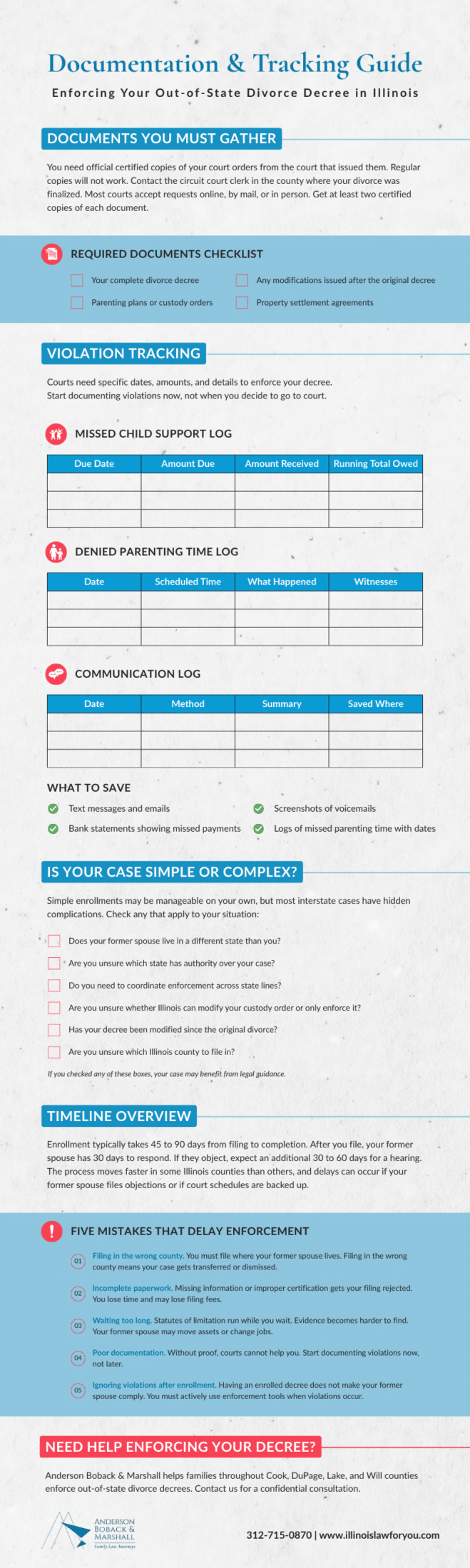
The guide walks you through exactly what to document, track, and gather, plus self-assessment questions to determine if your case is simple or complex and common mistakes to avoid.
Next Steps: Enroll Your Decree and Start Enforcement
Your out-of-state divorce decree has legal power in Illinois. Once you enroll it, and file a motion for enforcement, the Illinois courts will enforce your rights. The longer you wait, the more difficult enforcement becomes.
What to bring to your consultation:
- Your certified divorce decree from your original state;
- Any modifications issued after the original decree;
- Documentation of violations including missed payments, denied time, and communications; and
- Your questions about enforcement options and timeline.
Contact Anderson Boback & Marshall for a confidential consultation about your case. We serve families throughout Cook County, DuPage County, Lake County, and Will County.
We will review your decree, assess your enforcement options, explain the registration process, and answer your questions about Illinois law. We handle interstate enforcement cases throughout the Chicago area and understand how Illinois law intersects with out-of-state decrees.
Common Questions About Enforcing Out-of-State Divorce Decrees in Illinois
Can I enforce my out-of-state divorce decree in Illinois without filing anything?
For child support, yes. Illinois automatically recognizes out-of-state child support orders. You can pursue enforcement without formal enrollment.
For everything else including custody, maintenance, and property division, you must register your decree first. Without enrollment, Illinois courts cannot help you enforce those provisions.
How long does it take to enroll a foreign divorce judgment in Illinois?
Enrollment takes 45 to 90 days from filing to completion. If your former spouse objects, add another 30 to 60 days for a hearing. The process moves faster in some Illinois counties than others and depends on how quickly you provide required documentation and whether your paperwork is complete when filed.
Can I collect past-due child support or maintenance from my out-of-state decree?
Yes, but statutes of limitation may apply to very old debts. You can collect arrears with proper documentation including proof of the original order, payment records, and total arrears owed.
Interest accrues on unpaid support at 9% per year, so older debts grow substantially. The sooner you act, the more you can collect and the easier enforcement becomes.
What enforcement options do I have when my former spouse violates my enrolled out-of-state divorce decree in Illinois?
Enrollment alone does not force compliance. You must actively use enforcement tools when violations occur.
Your options include filing petitions or motions for contempt proceedings, obtaining wage withholding orders, placing liens on property, pursuing license suspension, and using bank account garnishment. Each violation gives you grounds for enforcement. Repeated violations strengthen your case for more serious remedies. An attorney can help you escalate enforcement strategically.
Do I need an attorney to enroll and enforce my out-of-state decree in Illinois?
Simple enrollments may be manageable on your own, but most interstate cases have hidden complications including jurisdictional questions about which state can do what, procedural requirements that vary by county, strategic decisions about enforcement approaches, and coordination between multiple states’ court systems.
Common mistakes without legal help include filing in the wrong county with case dismissed or transferred, incomplete paperwork resulting in filing rejection and need to start over, missing deadlines that lose enforcement opportunities, and choosing wrong enforcement tools that waste time and money.
An experienced attorney ensures enrollment is done correctly the first time and maximizes your enforcement success.
How much does it cost to enforce an out-of-state divorce decree in Illinois?
Costs depend on several factors including whether your former spouse contests registration, which county you file in, complexity of your decree, which enforcement tools you need to use, and whether violations continue after registration.
During a consultation, we review your specific situation and discuss the investment required to enforce your rights. We also discuss expected outcomes so you can make an informed decision about pursuing enforcement.