


You fought hard for your divorce settlement. The judge signed the judgment. You thought the hardest part was over. Now your ex-spouse refuses to follow through, and you are left wondering if your divorce decree is worth the paper it is printed on.
Illinois courts have authority to enforce divorce judgments. Under 750 ILCS 5/508, the court that entered your divorce decree retains the power to compel compliance. You do not have to accept noncompliance.
Key Takeaways
- Your divorce decree is a court order that can be enforced under Illinois law
- Enforcement typically requires filing a motion or petition with the court
- Civil contempt is a common tool Illinois courts use to compel compliance – repeated, unreasonable failure to comply can result in the incarceration of your spouse
- Courts can order deadlines, require document execution, and award attorney fees if you needed a lawyer to gain compliance with the Court’s order
- Enforcement is different from modifying the original order, but you have the power to modify an Order to make it enforceable if it is not already
What Does Noncompliance With a Divorce Judgment Look Like in Illinois?
Noncompliance occurs when one spouse fails to follow the terms of the divorce decree. This is not about disagreeing with the judgment or wishing things had gone differently. Noncompliance means one party is actively refusing to do what the court ordered.
Sometimes noncompliance is obvious. Your ex will not sign the deed to transfer the house. Other times, it is more subtle. Your ex drags their feet on paperwork or claims they “forgot” to contact the retirement plan administrator.
Regardless of how it looks, the result is the same. You cannot move forward with your life because your ex will not honor the agreement.
Common Ways an Ex-Spouse Refuses to Follow Property Division Orders
Property division in Illinois often requires action from both parties after the divorce is final. The judgment tells each spouse what they are entitled to receive. Receiving it requires cooperation.
These are the most common scenarios where an ex-spouse refuses to comply.
What Happens When Your Ex Will Not Sign the Deed or Transfer Real Estate?
Real estate transfers require specific documents. If the divorce decree awards you the marital home, your ex typically must sign a quitclaim deed to remove their name from the title. When they refuse, the title remains clouded, and you cannot refinance or sell the property.
Illinois courts can order your ex to sign. In some cases, the court can appoint someone to execute the deed on their behalf. The transfer will happen with or without their cooperation.
What Happens When Your Ex Will Not Cooperate With a QDRO or Retirement Transfer?
Retirement accounts require a Qualified Domestic Relations Order, commonly called a QDRO, to divide the funds. The plan administrator will not release your share without this document and your ex-spouse’s cooperation.
When your ex refuses to sign QDRO paperwork or ignores requests from the plan administrator, your retirement funds remain stuck. Enforcement proceedings can compel their participation and hold them accountable for the delay.
What Happens When Your Ex Will Not Pay What They Owe From the Property Settlement?
Many Illinois divorce settlements include a cash payment from one spouse to the other to balance the division of assets. One spouse may owe the other a specific dollar amount as part of the property settlement. When your ex will not pay, you are left without the funds you were awarded.
Courts have several tools to collect these payments. They can set payment deadlines, order wage garnishment, or pursue other collection remedies available under Illinois law.
What Happens When Your Ex Will Not Refinance or Sell the Home as Ordered?
Sometimes divorce judgments require one spouse to refinance the home to remove the other from the mortgage. Other judgments order the home sold and the proceeds divided. Review this blog for more guidance on dividing the family home in an Illinois Divorce.
When your ex will not take these steps, you remain financially tied to a property you no longer own. Your credit is at risk if payments fall behind. Illinois courts can order compliance and set firm deadlines to force action.
What Happens When Your Ex Will Not Turn Over Personal Property?
Divorce judgments in Illinois often divide personal property like vehicles, furniture, jewelry, or family heirlooms. When your ex refuses to hand over items awarded to you, enforcement proceedings can compel them to return what is rightfully yours.
Why Does a Divorce Decree Not Automatically Transfer Property in Illinois?
Many people expect that once the judge signs the divorce decree, property automatically changes hands. This is a common misconception.
A divorce decree is a court order telling each party what they must do. It does not physically transfer assets. Banks, title companies, retirement plan administrators, and lenders all require specific documents and cooperation to complete transfers.
Think of the divorce decree as the instructions. The actual transfer requires following those instructions, and that is where noncompliance creates problems.
Financial institutions and government agencies have their own requirements. They need signatures, specific forms, and proper documentation. When your ex will not participate, the transfer stalls even though the court has already ordered it.
How Do You Enforce a Property Division Order in Illinois?
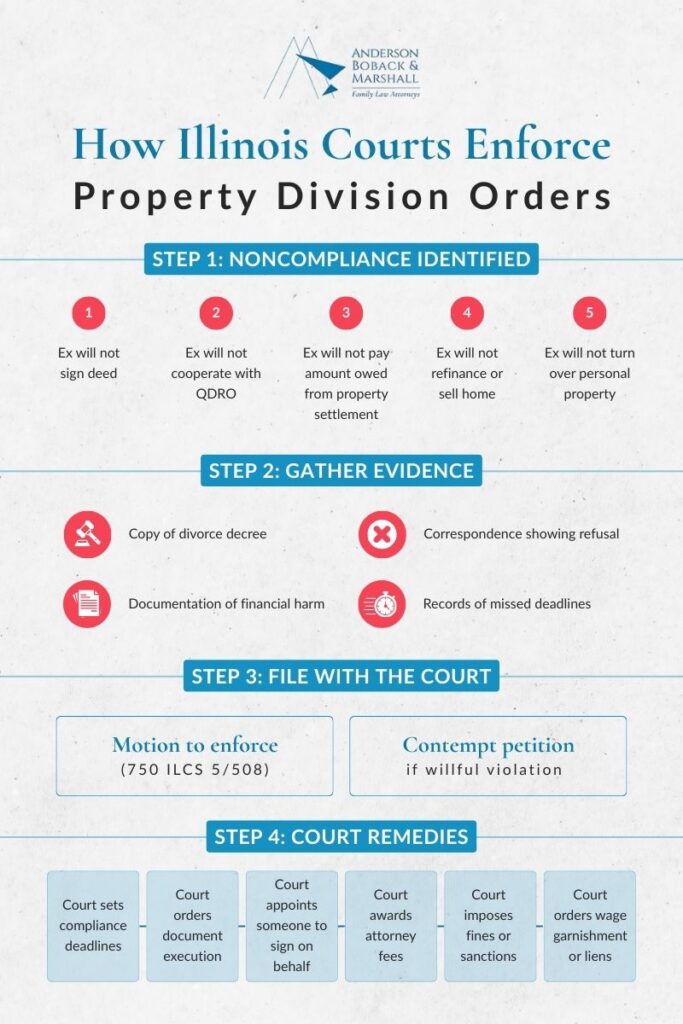
Illinois law provides clear pathways for enforcing divorce judgments. You do not have to tolerate noncompliance indefinitely. The process typically involves identifying the violation, gathering evidence such as your divorce decree and correspondence, filing a motion to enforce or contempt petition, and obtaining court remedies like compliance deadlines, fee awards, or wage garnishment.
What Is a Motion to Enforce a Divorce Judgment in Illinois?
Enforcement typically begins by filing a motion or petition with the court that entered your divorce decree. This formal request asks the court to compel your ex-spouse to comply with the judgment.
Under 750 ILCS 5/511, the court has broad authority to enforce its orders. Your motion explains what your ex was supposed to do, documents their failure to comply, and requests specific relief, usually complete compliance with a deadline.
This is where having an experienced family law attorney matters. The motion must be properly drafted and supported by evidence, as well as an attestation that the motion you are bringing is truthful and accurate. Courts in Cook, DuPage, Lake, and Will counties see many enforcement cases, and judges expect parties to follow proper procedures.
Can Your Ex Be Held in Contempt for Violating the Divorce Decree?
Yes. Civil contempt is one of the most powerful enforcement tools available in Illinois.
When someone violates a court order, they can be held in contempt. Civil contempt is coercive rather than punitive. The goal is to compel compliance, not to punish. Your ex holds the keys to their own freedom by simply doing what the court ordered.
Bringing a successful contempt petition requires showing that a valid court order exists, your ex knew about the order, and they willfully failed to comply. The burden then shifts to your ex to explain why they did not follow through.
Contempt proceedings can be highly effective. The threat of sanctions, including incarceration, often motivates compliance before a hearing even takes place.
Related Article: How Can I Enforce a Court Order Against My Ex?
What Can an Illinois Court Do If Your Ex Will Not Comply?
Illinois courts have significant authority to enforce divorce judgments. Depending on the situation, a court may order several remedies.
Courts can set firm deadlines for compliance. They can order your ex to execute specific documents like deeds or QDRO paperwork. In some cases, the court can appoint someone to sign documents on your ex’s behalf.
Financial penalties are also available. Courts can order your ex to pay your attorney fees incurred in bringing the enforcement action. They can impose fines or sanctions for continued noncompliance.
For monetary judgments, courts can enter execution orders allowing collection through wage garnishment or liens on property.
What Evidence Do You Need to Enforce a Divorce Judgment in Illinois?
Strong evidence makes enforcement cases more straightforward. Before meeting with an attorney, gather documentation showing your ex’s failure to comply.
Start with a copy of your divorce decree. Highlight the specific provisions your ex has violated. Collect any correspondence showing your attempts to get them to comply and their refusal.
For real estate issues, gather title records and any communications with title companies. For retirement accounts, document your interactions with plan administrators and your ex’s failure to participate.
Courts in Cook, DuPage, Lake, and Will counties expect clear evidence. Documentation of each missed deadline, ignored request, and broken promise strengthens your case.
Keep records of any financial harm you have suffered due to the delay. If you paid fees, lost opportunities, or incurred costs because of your ex’s noncompliance, document those losses.
Related Reading: Enforcement disputes sometimes overlap with double dipping between support and property division, where the same asset is counted twice.
Frequently Asked Questions About Enforcing Property Division Orders in Illinois
What happens if my ex refuses to follow the property division order in Illinois?
You can file an enforcement motion or contempt petition with the court that entered your divorce decree. Under 750 ILCS 5/511, Illinois courts have authority to compel compliance with divorce judgments. The court can set deadlines, impose sanctions, award attorney fees, and take other steps to force your ex to follow the order.
Can an Illinois court force someone to sign a deed after divorce?
Yes. Illinois courts can order a noncompliant spouse to sign a quitclaim deed or other transfer documents. If they continue to refuse, the court can appoint someone to execute the deed on their behalf. The transfer will occur with or without their willing participation.
What if my ex delays a retirement transfer or will not cooperate with a QDRO in Illinois?
Retirement account divisions require cooperation to complete the QDRO process. When an ex-spouse refuses to participate, you can file an enforcement motion under 750 ILCS 5/511 and a petition for attorneys’ fees if incurred pursuant to Section 508 of the Illinois Marriage and Dissolution of Marriage Act. The court can order compliance, set deadlines, and hold your ex in contempt for continued refusal.
Is refusing to transfer assets considered contempt in an Illinois divorce?
Willfully refusing to comply with a court order can constitute civil contempt. You must show that a valid order exists, your ex knew about it, and they failed to comply without justification. Civil contempt is coercive, meaning your ex can avoid sanctions by simply complying with the order.
Can I recover attorney fees if I have to enforce my divorce judgment in Illinois?
In many enforcement cases, Illinois courts can order the noncompliant spouse to pay the other party’s reasonable attorney fees. This recognizes that you should not have to bear the cost of forcing your ex to do what they were already ordered to do.
How long does enforcement of a divorce judgment take in Illinois?
Enforcement timelines vary based on the complexity of the issues, court schedules, and your ex’s response. Some cases resolve quickly once a motion is filed. Others require hearings and ongoing court involvement. An experienced attorney can give you a realistic timeline based on the specifics of your situation.
Can property division be modified after the divorce is final in Illinois?
Unless agreed between you and your spouse in a Court Order, property division is generally final and cannot be modified once the divorce decree is entered. Enforcement is different from modification. Enforcement compels compliance with the existing order. Modification, addressed under 750 ILCS 5/510, applies to ongoing obligations like maintenance or child support. If you are wondering whether you can reopen a divorce settlement in Illinois, the answer is rarely yes for property division.
When Should You Talk to an Illinois Divorce Attorney About Enforcement?
Do not wait for your ex to run out the clock. If your divorce decree is not being honored, talk to an attorney about your options sooner rather than later.
At Anderson Boback & Marshall, we have helped clients throughout Cook, DuPage, Lake, and Will counties enforce their divorce judgments. With over 35 years of combined family law experience, we understand the frustration of fighting for something you already won.
You deserve the property division you were awarded. Illinois courts have the tools to make it happen. We can help you use them.
Contact us today to schedule a consultation about enforcing your divorce judgment.