
Chicago Child Custody Lawyers

Chicago Child Custody Lawyers
Home / Chicago Child Custody Lawyers
Trusted Chicago Child Custody Lawyers for Complex Child Custody and Parenting Disputes
Our Chicago child custody lawyers represent Illinois parents and families, from proactively managing child visitation schedules and parental responsibilities allocation agreements to fighting complex child custody battles.
Experienced Chicago Child Custody and Parenting Lawyers
Anderson Boback & Marshall are family and child custody lawyers with extensive experience in all child-related cases, helping our clients to determine the best child custody plan for all parties involved. We listen to your concerns and help develop the plan that is in the best interest of the child, relieving a lot of stress for the parents and the children. Protect Your Parental Rights with Our Chicago Child Custody Lawyers.
Protecting Your Parental Rights in Chicago Custody Cases
When a couple with children decide to divorce or separate, child custody and visitation can be one of the most emotional and contentious issues to settle. Our Chicago Child custody lawyers provide guidance during child custody cases, which is always an emotional time for both parents and children. The main focus in any child custody case must always be on what is in the best interest of the child.

Understanding Child Custody in Illinois: What Parents Need to Know
When parents decide to separate, addressing child custody is a top concern. While common terms like “joint custody”, “sole custody” and “visitation” come to mind, this terminology is no longer used in Illinois. Instead, custody and visitation is replaced with the terms “allocation of parental responsibilities” and “parenting time”.

When parents divorce or separate, rather than entering into a “Custody Agreement” an Illinois family law court will enter an “Allocation Judgment”. Allocation Judgments allow the parents to pick and choose, or allocate, which responsibilities and child custody arrangements they will be responsible for as it relates to their child.

One parent can now be responsible for school decisions and the other can be responsible for medical care.

If the parents choose to continue sharing those responsibilities, the agreement can be written that way as well.
Parenting Time vs. Decision-Making Authority
Illinois no longer uses the terms “custody” and “visitation” in its family courts. Under 750 ILCS 5/602.5, these concepts have been replaced by the allocation of parental responsibilities. This system has two components: significant decision-making authority and parenting time.
Significant decision-making authority determines which parent makes major decisions about the child’s education, healthcare, religion, and extracurricular activities. Parents can share this authority jointly. The court can also assign specific areas to each parent based on the child’s needs.
Parenting time refers to the schedule that determines when the child is in each parent’s care. This includes regular weekday and weekend schedules, holiday arrangements, and vacation time. The parenting time schedule is part of a formal parenting plan that must be approved by the court.
Understanding the difference between these two components is essential because they are negotiated and decided separately. An arrangement that works for decision-making authority may not be the right fit for parenting time. Our attorneys help you build a parenting plan that addresses both components in a way that reflects your family’s reality.

How Illinois Courts Decide Custody
Every custody decision in Illinois starts with one question: what arrangement serves the best interests of the child? This standard governs every aspect of a custody case, from the initial parenting plan to any future modifications.
The court examines a broad range of best interest factors. These include each parent’s relationship with the child, the child’s adjustment to home and school, any history of domestic violence, and each parent’s willingness to encourage a healthy relationship with the other parent. No single factor controls the outcome. The judge weighs the totality of the circumstances based on the evidence presented.
This is why preparation matters. The strongest custody cases are built on thorough documentation, credible testimony, and a clear presentation of why your proposed arrangement serves your child’s needs. Our attorneys have extensive experience presenting custody cases in Cook County and surrounding jurisdictions. We help you build the strongest possible case from day one.
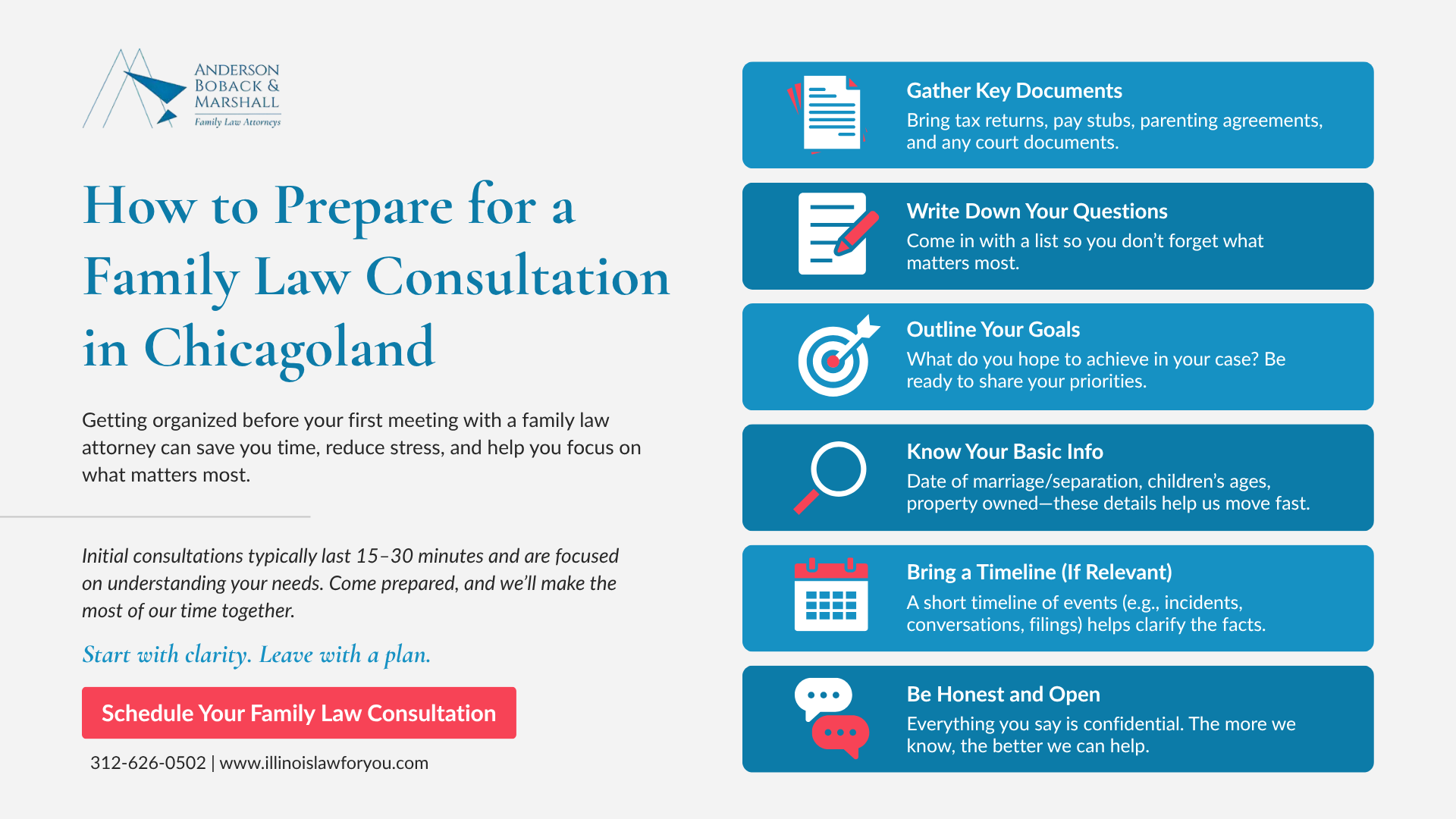
How Do Our Chicago Child Custody Attorneys Help You?
We help you sift through the legal jargon to answer the questions that matter most to you.
At Anderson Boback & Marshall, our experienced child custody and visitation attorneys will help you determine the best parental responsibility allocation arrangement that is in the best interest of your child. We understand that time with your children is one of the biggest causes of conflict during divorce.

With extensive experience helping clients resolve high conflict child custody cases, our Chicago family law attorneys have a track record of success addressing a wide range custody issues, including:
Our Child Custody Services
Initial Custody Determinations
Whether you are going through a divorce or establishing custody as an unmarried parent, the initial allocation of parental responsibilities sets the foundation for your child’s future. Our attorneys guide you through filing the petition, developing a proposed parenting plan, and presenting your case to the court. We represent parents in both negotiated settlements and contested hearings.
Custody Modifications
Life changes, and parenting plans sometimes need to change with it. When circumstances shift significantly, you may need to modify your custody arrangement. Common reasons include a parent’s relocation, changes in work schedules, a child’s evolving needs, or safety concerns. Illinois law requires showing a substantial change in circumstances before a modification is granted.
Enforcement of Custody Orders
A court order only protects you if it is enforced. When the other parent consistently fails to follow the parenting schedule, denies your parenting time, or violates decision-making provisions, we can file enforcement actions on your behalf. These include petitions for contempt. Courts take these violations seriously. Consequences can include make-up parenting time, fines, and attorney fee awards.
Relocation Cases
When a parent wants to move with the child beyond the distance thresholds set by Illinois law, a formal relocation petition is required. We represent both parents seeking court approval to relocate and parents contesting a proposed move. These cases have strict timelines and specific evidentiary requirements, making experienced legal representation essential.
What to Expect in Your Custody Case
If you are facing a custody case, knowing what to expect in family court can help reduce anxiety and allow you to prepare effectively. While every case is different, most Illinois custody cases follow a general path.
The process typically begins with one parent filing a petition for the allocation of parental responsibilities. If the situation involves an immediate safety concern, the court can issue temporary orders within days to protect the child. Otherwise, both parents are required to develop a proposed parenting plan.
Most Illinois counties require mediation before a custody case proceeds to trial. Mediation gives both parents the opportunity to negotiate the terms of their parenting plan with a neutral facilitator. Many cases are resolved at this stage without the need for a contested hearing.
If mediation does not produce an agreement, the case moves into the discovery phase. Both sides exchange relevant information during this stage. The court may also appoint a Guardian ad Litem or Child Representative to investigate the family’s circumstances and advocate for the child’s interests.
Throughout this process, your attorney is your guide. We help you prepare documentation, develop your case strategy, and stay focused on what matters most: securing a parenting arrangement that protects your relationship with your child. Learn more about what to expect in family court.
Protecting Your Parental Rights in Difficult Situations
Custody cases can involve serious challenges that go beyond disagreements about schedules. When these situations arise, having experienced legal representation is critical.
False Allegations
False allegations of abuse, neglect, or substance abuse are sometimes used as a strategy to gain leverage in custody disputes. These claims can have devastating consequences if not addressed immediately and effectively. Our attorneys work quickly to gather evidence, challenge unfounded allegations, and protect your parental rights.
Parental Alienation
When one parent systematically works to damage the child’s relationship with the other parent, it can cause lasting harm to both the child and the targeted parent. Signs include a child’s sudden refusal to visit, repeating negative statements about you that sound rehearsed, or the other parent consistently interfering with your communication. Illinois courts take parental alienation seriously. Documented patterns can influence custody decisions.
Interference with Parenting Time
If the other parent is consistently late for exchanges, refuses to follow the parenting schedule, or prevents you from communicating with your child, you have legal options. Illinois law provides enforcement mechanisms to hold the violating parent accountable and recover lost parenting time.
Emergency Custody Situations
When a child’s safety is at immediate risk due to domestic violence, substance abuse, or other dangerous circumstances, the court can issue emergency child custody orders to protect the child. These orders can be obtained quickly, but the legal requirements are strict. Our attorneys handle emergency custody petitions and can guide you through the process when time is critical.
Types of Child Custody Cases We Handle
Sole Custody
Cases
When one parent seeks primary decision-making authority due to the other parent’s substance abuse, instability, or inability to co-parent, the stakes are high. We help parents build the evidence and legal arguments needed to demonstrate that sole decision-making serves the child’s best interests.
Joint Custody
Arrangements
Many families benefit from arrangements where both parents share decision-making authority and meaningful parenting time. We help parents negotiate parenting plans that balance both parents’ involvement while maintaining stability for the child.
Relocation
Disputes
When a parent wants to move with the child beyond the distance limits set by Illinois law, the court evaluates the request using factors specific to relocation cases. For parents in Cook County, moves beyond 25 miles require either the other parent’s written consent or court approval. We represent both parents seeking permission to relocate and parents fighting to prevent a move that would disrupt the child’s stability.
Temporary Custody
Matters
When parents cannot agree on a custody arrangement while their case is pending, the court can issue temporary orders to provide stability for the child. These orders cover parenting time schedules and decision-making authority until a final resolution is reached. Temporary orders are easier to modify than final orders, but they carry full legal weight while in effect. Our attorneys help parents secure favorable temporary arrangements that often set the tone for the final outcome.
Enforcement of
Custody Orders
A parenting plan only works if both parents follow it. When the other parent repeatedly violates the custody order by missing exchanges, denying parenting time, or making decisions without your input, the court can step in. Violations of court orders carry serious consequences including make-up parenting time, fines, and attorney fee awards. We help parents document violations and present petitions that courts take seriously.
Frequently Asked Questions About Child Custody in Illinois
How does Illinois determine custody and the allocation of parental responsibility?
The Illinois Marriage and Dissolutions of Marriage Act requires the establishment of a parenting plan to determine the allocation of parental responsibility regarding parenting time and decision making on behalf of the child. A parenting plan includes how all significant parenting decisions will be made, how much time the child will spend in each home, how they will be transported back and forth and how holidays and vacations are shared.
What factors are considered when creating a parenting plan?
Child custody lawyers will help draft your parenting plan, which must be approved by the family court judge. When reviewing a drafted parenting plan, the judge will consider the following factors:
- The wishes of the child
- The wishes of both parents
- The relationship between the child, parents, and siblings that impact the child’s stability and happiness
- The impact of the parenting plan on the child’s happiness and performance in school
- The mental well-being and health of the parents and child
- Any issues of domestic violence
- Any issues of threats or child abuse
- Any issues of story of sex abuse of either parent
- The willingness of the parents to encourage a relationship with the other parent
Can an allocation of parental responsibilities be modified?
Once an allocation of parental responsibility is approved by the judge and becomes a court order that can only be altered by legal modification. An allocation judgment regarding parenting time can be modified at any time with a showing a change in circumstances making it necessary in order to serve the best interests of the child.
What if parents cannot agree on custody and allocation of parenting responsibilities?
If a child allocation plan cannot be reached through negotiation or mediation, formal child custody settlement negotiations in court may be required. While it is preferred that parents come to an amicable agreement, our custody lawyers always prepare to litigate in court as a last resort. Developing child allocation plans and establishing parenting time is always an emotional process, the last thing anyone wants is for the children to be caught in the middle.
What is an Emergency Child Custody Order?
An emergency child custody order is a temporary court order that grants immediate parenting time of a child to one parent. Typically, these orders are issued when a situation involves the child’s safety or well-being, such as abuse, neglect, or an immediate risk of harm. To obtain this order, you must demonstrate to the court that the situation is urgent and that the child may be in danger without swift legal action. Courts can be reluctant to issue these orders, and as such, an attorney may be necessary to obtain such an order.
Can I Get an Emergency Custody Order?
Yes, you can request sole custody of your child in Illinois, but it will depend on thecourt’s assessment of what is in the child’s best interests. Factors like the child’srelationship with each parent, the parents’ ability to provide a stable environment, andany history of abuse or neglect will be considered. The court typically favorsarrangements that allow both parents to be involved unless there is a reason to limit oneparent’s involvement.
What Happens When Parents Cannot Agree on a Child Custody Schedule?
When parents cannot agree on a child custody schedule, the court intervenes to make adecision based on the child’s best interests. The court examines factors like eachparent’s relationship with the child, their ability to provide a stable environment, and thechild’s educational, emotional, and physical needs. In some cases, the court may alsoappoint a guardian ad litem or child representative to investigate and represent thechild’s interests. The goal is to establish a custody arrangement that promotes thechild’s well-being, even if it means overriding parental disagreements. Absent anagreement, the court will make the decision once it hears the arguments.
What Should I Look for in a Custody Attorney for a High-Conflict Case in Cook County?
High-conflict custody cases in Cook County require attorneys experienced with the Domestic Relations Division at the Daley Center, familiar with local judges’ preferences, and skilled in working with Guardians ad Litems and Child Representatives. Look for someone who has handled cases involving complex matters such as parental alienation, relocation requests, or substance abuse concerns. Anderson Boback & Marshall attorneys have extensive courtroom experience in Cook County and regularly serve as court-appointed advocates for children in contested cases, giving us unique perspective on what the court considers when allocating parental responsibilities.
What Happens With Child Custody in an Illinois Divorce?
Illinois replaced traditional custody terminology with ‘allocation of parental responsibilities’ under 750 ILCS 5/602.5. Courts determine both decision-making authority (education, healthcare, religion, extra-curricular activities) and parenting time based on the child’s best interests. Factors include but are not limited to each parent’s relationship with the child, the child’s adjustment to home and school, and any history of domestic violence. Anderson Boback & Marshall attorneys regularly serve as both Guardian Ad Litems and Child Representatives appointed by Cook County courts, giving us unique insight into what judges prioritize.
Will I Lose Custody of My Child in an Illinois Custody Case?
This is one of the most common fears parents face, and it is completely understandable. In Illinois, courts do not automatically favor one parent over the other. The court’s primary focus is what arrangement serves the child’s best interests, not punishing or rewarding either parent.
Factors the court evaluates include each parent’s involvement in the child’s daily life, the stability of each home environment, and each parent’s willingness to support the child’s relationship with the other parent. A parent who has been actively involved in their child’s upbringing, maintains a safe home, and demonstrates a willingness to co-parent is well-positioned in a custody case.
An experienced custody attorney can help you understand how these factors apply to your specific situation. If you are worried about losing time with your child, understanding the reasons parents lose custody can help you avoid common pitfalls and strengthen your case.
What Is the Difference Between Parenting Time and Parental Responsibilities in Illinois?
In Illinois, what most people call “custody” is now divided into two distinct legal concepts. Parenting time refers to the schedule that determines when your child is with each parent. Parental responsibilities (also called “significant decision-making”) refers to which parent has the authority to make major decisions about the child’s education, healthcare, religion, and extracurricular activities.
These two components are decided separately. One parent might have the majority of parenting time while both parents share decision-making authority. The court may also assign specific decision-making areas to each parent based on the child’s needs and each parent’s strengths.
Understanding this distinction matters because it affects how your parenting plan is structured. Our attorneys help you navigate both components so your arrangement reflects what works best for your child and your family.
Can a Parent Move Out of Illinois or Relocate with a Child After Divorce?
Illinois law sets specific rules for when a parent wants to relocate with a child. Under 750 ILCS 5/609.2, whether court approval is needed depends on where you are moving and how far. If you currently live in Cook County, moves of more than 25 miles from your current residence require either the other parent’s written agreement or a court order. For parents living outside Cook County, the threshold is 50 miles.
If the other parent objects, the court evaluates the relocation using factors specific to relocation cases. These include the reason for the move, the impact on the child’s relationship with the non-moving parent, and whether a revised parenting schedule can preserve that relationship.
Relocation cases move quickly once filed, and the legal requirements are strict. If you are considering a move or responding to the other parent’s relocation request, early legal advice is essential.
Does My Child Get a Say in Custody Decisions in Illinois?
Illinois courts may consider a child’s wishes as one factor in custody decisions, but there is no specific age at which a child gets to choose where they live. The court looks at whether the child is mature enough to express a reasoned and independent preference. This is just one of many factors the judge weighs when determining the child’s best interests.
Courts are also careful to protect children from being put in the middle of parental disputes. A child is rarely asked to testify directly. Instead, the court may appoint a Child Representative or Guardian ad Litem to speak with the child privately and present their perspective to the judge.
If your child has expressed a strong preference about their living situation, an attorney can help you understand how a child’s preference may influence the court’s decision in your case.
How Long Does a Custody Case Take in Illinois?
The timeline for an Illinois custody case depends on several factors, including whether the parents can reach an agreement and the complexity of the issues involved. An uncontested case where both parents agree on a parenting plan may be resolved in a few months. A contested case that goes to trial can take 12 to 18 months or longer.
In situations involving immediate safety concerns, the court can issue temporary custody orders within days. These orders stay in place while the full case moves through the legal process. They provide stability for the child during a difficult transition.
Every case is different, and an experienced attorney can give you a more specific timeline based on the facts of your situation. The most important thing is to begin the process with strong preparation so your case is positioned for the best possible outcome.
Download our Illinois Child Custody Playbook Today!
Get the information you need for child custody with our free resource – Illinois Child Custody Playbook.
Chicago Child Custody Lawyers Ready to Fight for You:
Advocating for parents and their children is at the heart of what we do. Whether you are going through a divorce or you and the other parent were never married, you can count on our child custody attorneys to guide you with sound legal advice and aggressive representation to ensure the best outcome for you and your children.
We work diligently as your advocate during child custody cases. Don’t take any chances, work with experienced child custody attorneys to strategize the best parenting plan.